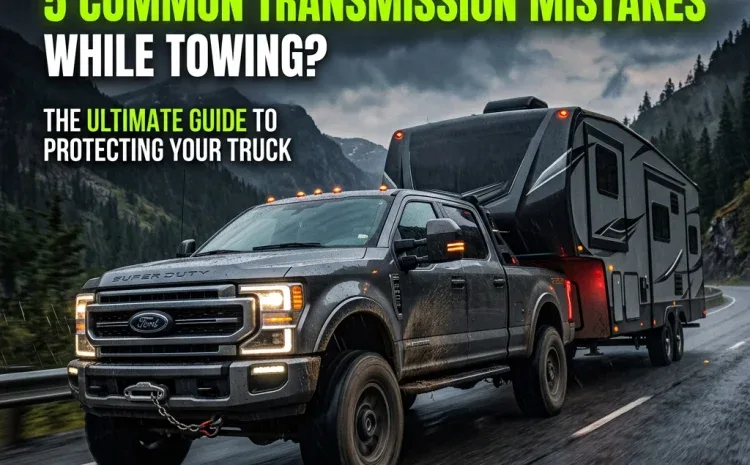
Are You Making These 5 Common Transmission Mistakes While Towing?
There is a specific kind of pride that comes with owning a heavy-duty truck. Whether you’re hauling a 30-foot fifth-wheel camper for a weekend getaway or dragging a flatbed loaded with equipment to a job site, your truck is your partner. It’s the muscle that makes your lifestyle possible. But here’s the reality: towing is the ultimate stress test for your vehicle, specifically for your transmission.
Think of your transmission like the heart of an elite athlete. When you’re cruising down the highway empty, that athlete is going for a light jog. But the moment you hitch up a trailer, you’re asking that athlete to sprint uphill while carrying a backpack full of rocks. If they aren’t prepared: or if they make a wrong move: something is going to snap.
At Dirty D’s Performance, we see a lot of trucks come through our doors with burnt-out clutches, sheared gears, and overheated fluid. Often, these issues could have been avoided with a little bit of “towing IQ.” If you’re a truck owner who relies on your rig for heavy lifting, you need to know if you’re inadvertently sabotaging your drivetrain.
Here are the five most common transmission mistakes people make while towing, and how you can avoid a costly trip to the shop.
1. Towing with the Drive Wheels on the Ground
This is arguably the most “silent” killer of transmissions. If you are towing another vehicle behind your truck, or if your truck itself ever needs a tow, the orientation of the wheels matters immensely.
The Mistake: Towing a vehicle with its drive wheels rolling on the pavement while the engine is off.
The “Why”: Inside an automatic transmission, the fluid pump is driven by the engine’s input. When the engine is off, the pump isn’t spinning. However, if the drive wheels are on the ground and moving, the internal gears and bearings are still spinning at high speeds. Without the pump running, there is no lubrication or cooling happening. It’s like trying to run a marathon while holding your breath: within a few miles, the internal friction generates enough heat to melt seals and weld gears together.
The Fix: If you’re towing a rear-wheel-drive vehicle, the rear wheels need to be off the ground (on a dolly or a flatbed). If it’s a 4WD or AWD vehicle, a flatbed is usually the only safe option. Always consult your owner’s manual or a pro at our transmission repairs department before you hook up.

2. Exceeding Your Gross Combined Weight Rating (GCWR)
We get it: modern diesel trucks are incredibly powerful. A tuned Cummins can feel like it could pull a house off its foundation. But just because the engine can pull the weight doesn’t mean the transmission can survive it.
The Mistake: Treating your manufacturer’s towing capacity as a “suggestion” rather than a hard limit.
The “Why”: Your transmission is designed to handle a specific amount of torque and heat. When you exceed the Gross Combined Weight Rating (the total weight of the truck plus the trailer), you’re forcing the torque converter to work overtime. This creates a massive amount of heat. Think of it like a “tailored suit”: the suit fits perfectly when you’re at your target weight, but if you try to squeeze in after gaining twenty pounds, the seams are going to burst. In your transmission, those “bursting seams” are your clutch bands slipping and your fluid breaking down.
The Deeper Dive: When fluid gets too hot (typically above 220°F), it loses its ability to protect the metal components. If you’re frequently hauling heavy, you might need to look into custom truck work to upgrade your cooling system or install a heavy-duty torque converter.
3. Ignoring the “Tow/Haul” Mode and Gear Selection
Many drivers ignore that little button on the dash or the ability to manually select gears, thinking the computer knows best. While modern TCMs (Transmission Control Modules) are smart, they aren’t psychic.
The Mistake: Staying in Overdrive while climbing steep grades or forgetting to engage Tow/Haul mode.
The “Why”: Tow/Haul mode changes the shift points, keeping the engine in its power band longer and preventing the transmission from “hunting” for gears. Hunting: where the transmission constantly shifts back and forth between 5th and 6th gear: generates an incredible amount of heat. Furthermore, failing to downshift manually on a descent means you aren’t using engine braking, which puts all the stress on your brakes and keeps the transmission in a high-load state.
The Fix: Engaging Tow/Haul mode is like giving your transmission a “heads up” that work is coming. It increases line pressure, which helps the clutches hold tighter and prevents slipping. For those looking for maximum reliability, maximizing Cummins engine performance often involves ensuring the engine and transmission are communicating perfectly through proper tuning.

4. The “Park” Pawl Myth
We’ve all seen it: someone hitches up a heavy trailer on a slight incline, puts the truck in “Park,” and lets it roll back until it “clicks” and stops.
The Mistake: Relying on the transmission’s “Park” setting to hold the weight of the truck and trailer.
The “Why”: Inside your transmission is a small metal component called a parking pawl. It’s about the size of a finger. When you put the truck in Park, this little pin drops into a gear to stop the output shaft from spinning. If you’re on a hill with 10,000 lbs behind you, you are putting a monumental amount of shear force on that tiny piece of metal. If it snaps, your truck becomes a runaway train. Even if it doesn’t snap, it can become jammed, making it nearly impossible to shift out of Park.
The Fix: Always use your parking brake. Stop the truck, keep your foot on the service brake, engage the parking brake, and then shift into Park. This ensures the weight is held by the suspensions and brakes rather than the delicate internals of your gearbox.
5. Neglecting Fluid Maintenance and Cooling
If the transmission is the heart, the fluid is the blood. In the world of diesel performance, “old blood” leads to a quick death.
The Mistake: Assuming that “Lifetime Fluid” actually lasts a lifetime, especially when towing.
The “Why”: Towing causes transmission fluid to oxidize at a much faster rate. For every 20 degrees you go above the optimal operating temperature, you effectively cut the life of your fluid in half. If you’re towing through the mountains in the summer, your fluid is working harder than you realize. Dark, burnt-smelling fluid is a sign that it has lost its viscosity and its ability to carry heat away from the clutches.
Practical Example: We recommend a “check-up” approach. Just like you wouldn’t go years without a dental cleaning, you shouldn’t go years without checking your transmission health. Regular general maintenance is the cheapest insurance policy you can buy for your truck.

Protecting Your Investment
Your truck is more than just a tool; it’s an investment in your freedom and your productivity. Whether you’re worried about your fuel system health or the longevity of your Cummins engine, the transmission is often the piece of the puzzle that gets overlooked until it’s too late.
If you’ve been making these mistakes, don’t panic: but do act. Small changes in how you tow can add years to the life of your drivetrain. If you’re noticed your truck shifting a bit harder than usual, or if you’ve seen that temperature gauge climb into the red during your last haul, it might be time for a professional “pit crew” to take a look.
At Dirty D’s Performance, we specialize in making sure your rig is ready for whatever load you throw at it. From truck work that strengthens your chassis to precision Cummins engine repairs, we’re here to keep you on the road and off the shoulder.
Not sure if your transmission is up to the task of your next big trip? Don’t leave it to chance. Contact us today to schedule a transmission health check and ensure your truck is as reliable as the day you bought it. Let’s make sure your “athlete” is ready for the sprint.