Do You Really Need New Injectors? Here’s the Truth About Cummins Fuel System Health
If you own a Cummins-powered truck, you’ve likely felt that sudden pit in your stomach when the engine stumbles at a stoplight or starts blowing a hazy cloud of white smoke on a cold morning. In the diesel world, the “I” word, Injectors, is often treated like a four-letter word. It’s the repair everyone fears because, let’s be honest, a full set of high-quality injectors isn’t exactly pocket change.
But here is the truth that many shops won’t tell you: just because your truck is acting up doesn’t automatically mean you need to drop thousands on a brand-new set of sticks. At Dirty D’s Performance, we view ourselves as your personal pit crew. We aren’t here to just sell you parts; we’re here to ensure your rig is running at its absolute peak.
In this guide, we’re going to peel back the curtain on Cummins fuel system health. We’ll look at when you can save your current injectors, when it’s time to say goodbye, and how you can keep your fuel system humming for 250,000 miles or more.
The “Check Engine” Anxiety: Validating Your Situation
Consider how you use your truck. Are you towing heavy loads through the mountains, or is your Cummins a dedicated daily driver that occasionally sees a trailer on the weekends? Your driving habits dictate the stress placed on your fuel system. If you’ve noticed a decrease in fuel economy, a “knocking” sound that wasn’t there before, or a rough idle that makes the whole cab shake, you are right to be concerned.
However, diagnosing a fuel system is like being a detective. You don’t just arrest the first suspect you see. You have to look at the evidence. Often, symptoms that mimic injector failure can actually be rooted in general maintenance issues or minor sensor glitches.

Diagnostic Bench Testing: The Only Way to Know for Sure
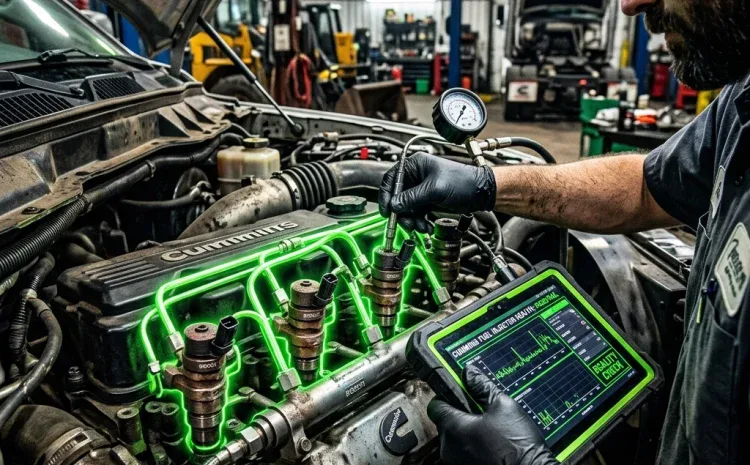
In the same way a doctor wouldn’t perform surgery based on a “hunch,” we don’t recommend replacing injectors without concrete data. The gold standard for Cummins health is bench testing on a Bosch-certified test stand.
What Happens During a Bench Test?
When we pull your injectors and put them on the stand, we aren’t just looking to see if they “squirt” fuel. We are measuring precision metrics:
- Pilot Injection: This is the small “pre-shot” of fuel that keeps your engine quiet and smooth. If this fails, you get that classic loud diesel clatter.
- Full Load Flow: We simulate your truck pulling a heavy grade. Is the injector delivering the exact volume required, or is it falling short?
- Return Fuel Volume: This is a big one. If too much fuel is returning to the tank instead of going into the cylinder, your rail pressure drops, and your truck loses power.
If an injector fails these tests, then: and only then: do we talk about a fuel system repair. In many cases, we find that only one or two injectors are the culprits, allowing for a more tailored and cost-effective solution rather than a “blanket” replacement of all six.
Cleaning vs. Replacement: The Tailored Approach
Think of your injectors like a high-end tailored suit. Over time, that suit might get a little dirty or need a minor stitch. You wouldn’t throw the whole suit away because of a loose button, right?
Many Cummins injectors can be saved through professional cleaning and recalibration. This is especially true if the issue is carbon buildup on the tips or minor internal stiction. We’ve explored this in depth in our guide on fuel injector cleaning vs. replacement.
Practical Example: The “Dirty” Truth
We recently had a customer come in convinced they needed $3,000 worth of new injectors. After a diagnostic sweep, we found that their fuel-water separator hadn’t been changed in two years. The injectors were struggling because the fuel was “starving” before it even reached them. A simple filter change and a professional fuel system purge saved them over $2,500. This is why regular general maintenance is the ultimate insurance policy.

The Silent Killers of Cummins Fuel Systems
To keep your injectors healthy, you have to understand what’s trying to kill them. It’s a three-pronged attack:
- Contamination: Diesel fuel is naturally “dirty.” Water, rust from storage tanks, and microscopic debris act like sandpaper inside your injectors. Because tolerances inside a Cummins injector are measured in microns (smaller than a human hair), even a tiny speck can cause a “cracked body” or a “faulty solenoid.”
- Heat and Friction: Fuel acts as the lubricant for your injectors. If your lift pump is weak, the injectors don’t get enough “lube,” leading to metal-on-metal wear.
- Lack of Use: Ironically, trucks that sit for long periods are often in worse shape than those that work daily. Stagnant fuel can turn into a varnish-like substance that clogs the delicate spray patterns.
If you’re worried about these issues, it’s worth checking out the signs you need fuel system maintenance before the damage becomes permanent.
Proactive Care: The “Dental Check-up” for Your Engine
You wouldn’t wait until your teeth fall out to visit the dentist, so why wait until your truck leaves you stranded on the side of the highway to check your fuel system?
A Deeper Dive into Filtration
The stock filtration on many Dodge Ram trucks is “adequate,” but barely. If you want to see 250,000 miles out of your injectors, you need to be proactive.
- Upgrade your filtration: Consider a secondary fuel filtration system that filters down to 2 microns.
- Use high-quality additives: A good cetane booster and lubricant can compensate for the “dryness” of modern Ultra-Low Sulfur Diesel (ULSD).
- Watch your gauges: If you notice your rail pressure fluctuating, don’t ignore it. It’s the engine’s way of whispering for help before it starts screaming.

When Replacement is the Only Option
Sometimes, the truth is that the injectors are simply worn out. Mechanical parts have a lifespan. If the internal ball and seat are eroded, or the solenoid is electrically “dead,” no amount of cleaning will bring them back to life.
When this happens, you have a choice. You can go with “off-the-rack” remanufactured injectors from a big-box website, or you can go with a custom Cummins engine repair plan. At Dirty D’s, we only use components that meet or exceed OEM specifications because we know that “cheap” injectors usually end up costing twice as much in the long run when they fail six months later.
Conclusion: Your Partner in Performance
At the end of the day, your Cummins is an investment. Whether it’s a tool for your trade or a part of your lifestyle, it deserves a level of care that goes beyond a simple “plug-and-play” diagnosis.
Do you really need new injectors? The answer is: maybe, but let’s find out for sure first. Don’t guess with your wallet. Let the experts at Dirty D’s Performance give your fuel system the thorough check-up it deserves. We treat every truck like it’s our own, providing reliable, honest advice to keep you on the road.
If you’re noticing any of the symptoms we talked about: or if you just want the peace of mind that comes with a healthy fuel system: reach out to us. We’re ready to be your personal pit crew.